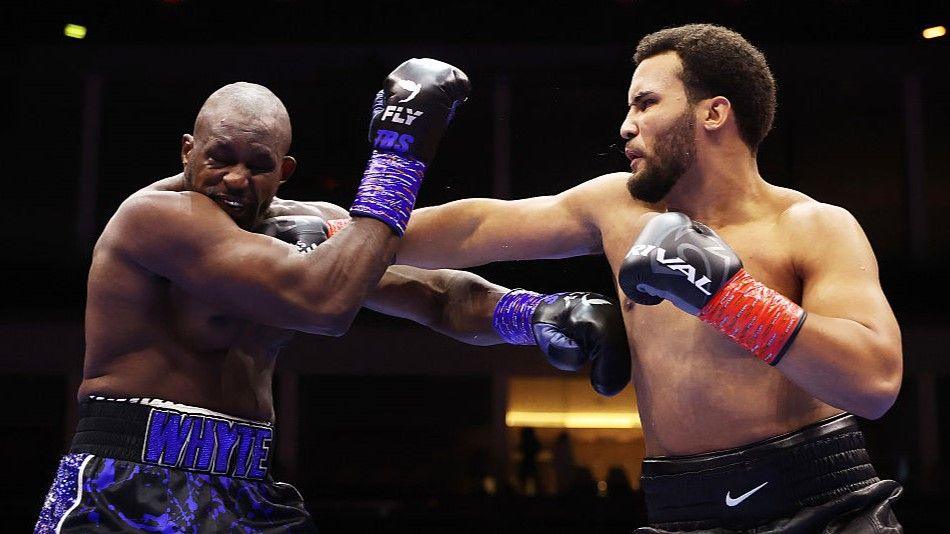
The heavyweight clash between Jake Paul and Anthony Joshua was far more than a celebrity crossover bout. It was a revealing case study in experience versus ambition, patience versus bravado, and elite fundamentals versus developing skill. What unfolded over six rounds was not chaos, but a carefully measured dismantling—one that exposed the unforgiving realities of heavyweight boxing.
From the opening bell, Joshua made it clear that he would not be rushed by hype or spectacle. His posture was tall and composed, his guard compact, his movements economical. Rather than chasing an early knockout, he treated the first round as a reconnaissance mission. A steady jab served as both rangefinder and deterrent, keeping Paul at a safe distance while allowing Joshua to read reactions—how Paul slipped, how he retreated, how he reset his feet. Paul, for his part, adopted a conservative shell, circling cautiously and throwing little. The psychological tone was set immediately: one man was collecting data, the other was focused on survival.
As the second round began, Joshua subtly increased the pressure. His jab came more frequently, accompanied by feints that froze Paul mid-step. These feints were crucial. Each twitch of Joshua’s shoulder forced Paul to react defensively, draining energy and confidence. Paul’s footwork began to widen, a sign of tension and fatigue creeping in earlier than planned. Though no single punch caused visible damage, the cumulative effect was unmistakable. Joshua was asserting control over space, tempo, and rhythm.
By the third round, the fight’s underlying narrative had become clear. Joshua was no longer simply probing; he was cutting the ring. Instead of following Paul, he stepped laterally to close exits, guiding him toward the ropes. Short right hands and stiff jabs found their way through Paul’s guard. Paul attempted to counter, but his punches lacked conviction and, more importantly, effect. When he clinched, it was not to work inside but to buy time. Even more telling was Joshua’s mid-round calm—he spoke to Paul, a veteran’s tactic designed to undermine confidence and reinforce dominance.
Round four was the most deceptive round of the fight. On the surface, Joshua appeared to slow slightly, but this was strategic restraint rather than fatigue. He allowed Paul moments of false encouragement, subtly inviting him forward. When Paul obliged, eager to prove he belonged, Joshua punished him with precise counters. A sharp uppercut snapped Paul’s head back, and for the first time, his reactions lagged behind the incoming shots. The gap between elite heavyweight timing and developing skill widened visibly.
The fifth round marked the beginning of the end. Joshua shifted from accumulation to execution. His punches came in combinations now—body shots to lower Paul’s guard, followed by crushing blows upstairs. The first knockdown arrived via a thunderous right hand that sent Paul to the canvas. Though Paul rose, the damage was undeniable. His eyes betrayed disorientation, his legs struggled to steady, and his defensive structure collapsed. Moments later, a left hook–right hand combination dropped him again. This was not merely physical domination; it was the breaking of resolve.
By the sixth round, the outcome felt inevitable. Joshua sensed it too. He advanced with calculated aggression, corralling Paul against the ropes and using the jab to lift the guard before unleashing power. The final sequence was brutal yet clinical: a right hand split the defense, a left hook crashed into the jaw, and Paul fell heavily. The referee’s stoppage was immediate and necessary. The fight was over at 1:31 of the round, not because of recklessness, but because of inevitability.
In retrospect, this bout was a masterclass in heavyweight fundamentals. Joshua did not rely on raw power alone; he relied on patience, positioning, and psychological pressure. Paul, courageous in his ambition, encountered the harsh truth of elite boxing—that size, experience, and composure cannot be fast-tracked. His journey into the heavyweight division met its first true reckoning here.
Ultimately, the fight reaffirmed a timeless principle of the sport: hype may sell tickets, but fundamentals decide outcomes. Joshua walked away having reasserted his authority, while Paul left with lessons that no training camp can simulate. In the unforgiving theater of heavyweight boxing, reality always arrives on schedule—and in this fight, it arrived with devastating clarity.