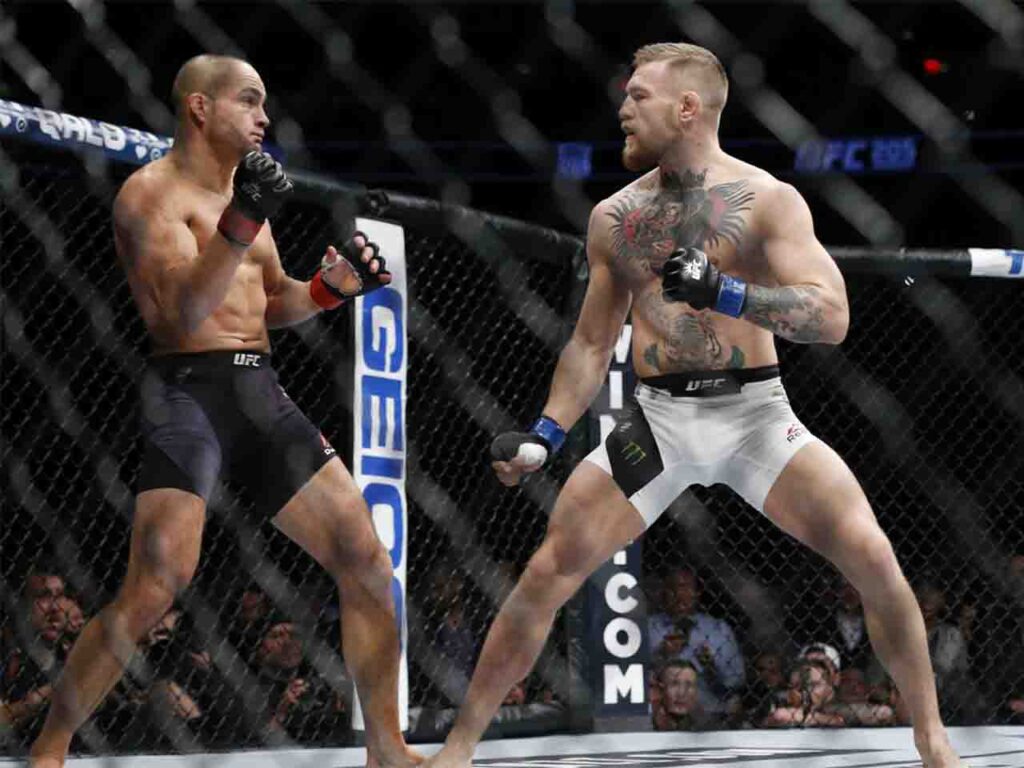
The so-called Andrew Tate vs Chase fight is less a fight in the traditional sporting sense and more a reflection of modern internet culture, where perception often outweighs reality. Stripped of social-media exaggeration, slow-motion clips, and sensational headlines, the incident stands as a revealing example of how combat sports experience, emotional control, and narrative framing collide in the digital age.
At the center of this controversy is Andrew Tate, a figure whose public persona often overshadows his legitimate background in professional kickboxing. Long before his online notoriety, Tate competed at a high level, developing the instincts that only years of real fighting can produce—distance management, timing, balance, and composure under pressure. Opposite him was Chase DeMoor, a physically imposing former college football player whose strengths lie in athleticism rather than structured combat training. This contrast would ultimately define the entire encounter.
The confrontation itself did not take place in a regulated arena, nor did it follow any officially agreed-upon rule set. There were no rounds, no judges, and no referee—only a gym environment shaped by bravado and mutual ego. This distinction is crucial. A real fight, whether boxing, MMA, or kickboxing, exists within rules designed to measure skill and control damage. What occurred here was closer to unsanctioned sparring, fueled by online taunts and the expectation of virality rather than sporting legitimacy.
When the two men engaged, the difference between experience and raw aggression became immediately apparent. Tate’s movement was measured and economical. He did not rush exchanges or chase a dramatic finish. Instead, he maintained structure—hands positioned correctly, feet under his body, eyes calm and observant. Chase, by contrast, appeared emotionally charged, relying on forward pressure and physicality rather than technique. This imbalance is common when trained fighters face untrained but athletic opponents. The trained fighter rarely needs to dominate physically; he only needs to let the other man make mistakes.
Psychology played as significant a role as technique. Tate remained composed, even dismissive, projecting confidence and control. Chase’s aggression, while intense, lacked direction. In combat sports, emotional excess often leads to overextension, poor balance, and vulnerability. The encounter illustrated a fundamental truth: fights are often decided mentally before they are decided physically. Tate’s calm presence contrasted sharply with Chase’s urgency, reinforcing the perception of dominance regardless of how brief or limited the exchange actually was.
What transformed this brief encounter into a viral “fight” was not what happened in the gym, but what happened afterward online. Short clips circulated without context, captions exaggerated outcomes, and audiences were encouraged to pick sides rather than understand circumstances. In the attention economy, nuance rarely survives. A sparring moment becomes a “beatdown,” restraint is interpreted as superiority, and absence of structure is ignored in favor of dramatic storytelling.
Ultimately, the Andrew Tate vs Chase incident tells us more about internet culture than combat sports. It demonstrates how years of professional training can be trivialized into highlight clips, and how physical size can be mistaken for fighting ability. It also highlights a dangerous misconception—that unsanctioned encounters can meaningfully determine who is the “better fighter.” Without rules, officials, and agreed conditions, such conclusions are meaningless.
In the end, this was not a contest meant to crown a winner. It was a collision of personas—one shaped by real fighting experience, the other by athletic confidence and online spectacle. The lesson is simple but often ignored: combat sports reward discipline, patience, and emotional control, not hype. And in a world driven by viral narratives, the loudest story is rarely the most accurate one.
“How Chase Defeated Andrew Tate” — Explaining the Claim vs the Reality
When people say “Chase defeated Andrew Tate,” they are not describing an official fight outcome. Instead, they are referring to a perceived moment of dominance during an unsanctioned gym encounter that was later reframed by social media as a “win.”
To answer your question properly, I’ll explain how people believe Chase won, and then clarify what actually happened.
🧠 Who Are the Two Figures?
- Andrew Tate
A former professional kickboxer with years of ring experience, trained in distance control, timing, and composure. - Chase DeMoor
A physically strong former football player with size and aggression, but no professional combat-sports résumé.
🥊 How the “Defeat” Narrative Was Created
1️⃣ Chase Pressured Forward Aggressively
During the encounter:
- Chase moved forward constantly
- He took the center of the gym space
- He showed no hesitation or fear
To casual viewers, forward movement looks like dominance, even though in real fighting it often exposes openings.
📌 Why this looked like a win:
Many fans equate aggression with control.
2️⃣ Tate Chose Not to Escalate
Andrew Tate:
- Did not throw full-power combinations
- Maintained distance
- Stepped back rather than brawling
In sparring, disengaging is normal, especially when:
- There are no rules
- No referee
- No protective structure
📌 Why this was misread:
Viewers assumed stepping back = losing, when it often means restraint.
3️⃣ The Exchange Ended Abruptly
The encounter stopped without:
- A knockout
- A knockdown
- A submission
- A referee decision
Because it ended suddenly, fans filled the gap with interpretation.
📌 Online conclusion:
“Chase stood his ground, Tate didn’t finish — therefore Chase won.”
This is a narrative leap, not a sporting conclusion.
📊 What Did NOT Happen (Very Important)
Chase did NOT:
- Knock out Tate
- Drop Tate
- Force a stoppage
- Win a decision
- Submit Tate
So there was no technical or official defeat.
🧠 Why Some People Still Say “Chase Defeated Tate”
There are three psychological reasons:
🔹 Optics Over Technique
Aggression looks impressive on camera.
Defense and restraint do not.
🔹 Anti-Tate Bias
Andrew Tate is polarizing.
Any moment where he doesn’t dominate is framed as a loss.
🔹 Lack of Combat Sports Knowledge
Many viewers don’t understand:
- Sparring etiquette
- Controlled exchanges
- Why experienced fighters avoid chaos
🧾 The Honest Verdict
- ❌ There was no fight
- ❌ There was no score
- ❌ There was no winner
- ❌ Chase did not defeat Tate in any official sense
✔ What happened was an unsanctioned sparring encounter
✔ The “defeat” exists only in internet storytelling
🧠 One-Line Truth
Chase did not defeat Andrew Tate — people simply interpreted aggression and an unfinished exchange as a win.